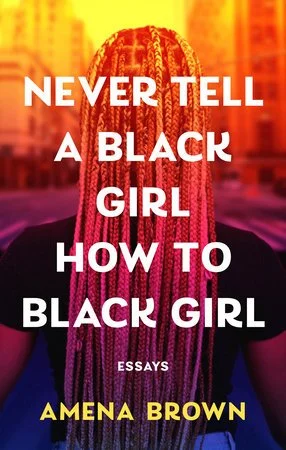
Never Tell a Black Girl How to Black Girl (now available)
An irresistible delight, this hilarious and heartwarming essay collection gathers essential tales about growing up in the South, the pitfalls of date night, and why no one should ever tell a Black girl how to Black Girl.
Black women always find a place to meet: in the natural hair aisle, at Beyoncé concerts, even online in memes and catchphrases. This book is one of those places: a living room where readers can contemplate how a well-picked afro can defy the laws of physics and why boob sweat has to exist in the first place. Here, Black Girl is a verb. Here, Black women can Black Girl in every way we want to.
Amena Brown’s book Never Tell a Black Girl How to Black Girl blends storytelling, humor, and pop culture commentary to traverse the magic and wisdom she’s gleaned from being raised by Southern Black women, and supported by the community of Black women who hold her down today. After graduating from the International Black Girl Headquarters (the renowned HBCU Spelman College), Amena has built a career telling stories and celebrating Black womanhood. In her book, she shares stories of dancing in Janelle Monae’s “Tightrope” music video and partnering with Tracee Ellis Ross to compose odes to natural hair. She imparts essential life lessons from the Real Housewives of Atlanta, and tells hair tales, including wisdom on the ideal style for her first speaking gig at Essence Fest (box braids, 100 percent).
In the end, Brown shares that Black women are a whole world. A galaxy of customs, language, code, and unspoken understandings, all explored with humor and heart in this unforgettable book.
More Information
Publisher: Tiny Reparations Books
Original Release Date: June 16, 2026
Formats: Hardcover, eBook, Audiobook
Hardcover ISBN: 979-8217044689
Praise
“A rich love letter to Black women and their multitudes.” —Kirkus, starred review
“Readers of Brown’s generation will feel like they’re hearing from an old friend.” —Library Journal
“Amena Brown has always been a wordsmith, but in this latest book she releases her comedic charm in ways that make you feel like you're giggling with your best friend. If you enjoy the writings of Samantha Irby and Phoebe Robinson, prepare to sign up for your next fanclub membership for Amena Brown.” —Austin Channing Brown, NYT bestselling author of I'm Still Here: Black Dignity in a World Made for Whiteness
“This book is a love letter to Black girls who are tired of being instructed instead of understood. It honors our complexity, or stories, and the right to be different and the same all at the same time.” —Tarriona “Tank” Ball, Grammy-winning recording artist, poet, and author of Vulnerable AF
“This book is an homage, an ode, a mirror to being a Black girl. I lost count of how many times I laughed out loud or took a long exhale while reading and said, ‘Yes. Same!’" —Morgan Harper Nichols, Artist and Author of All Along You Were Blooming
“The touching and hilarious essays in Never Tell a Black Girl How to Black Girl beautifully explore shared cultural experiences and the various ways one can ‘Black girl’ — yes, that’s a verb. Amena Brown’s collection is essential reading for everyone, but especially for the Black girls who contain multitudes and are looking for themselves in relatable, heartwarming writing.” —Char Adams, journalist and author of Indie Next pick Black-Owned
“Beautiful. Brilliant. Unapologetically Black. Amena writes Black girlhood and womanhood with humor, tenderness, and truth; this book is a love letter and a roadmap all at once. This is the big-sister-hug of a guide I personally wish I’d had sooner for navigating the beauty, complexity, and wonder of becoming.” —Arielle Estoria, poet, actor, and author of The Unfolding
“Full of sacred stories, powerful moments of connection, and vulnerable poetry that reminds Black women to passionately claim who they are, this book is a balm and a teacher, and I hope when you read it you let its wisdom reach you, teach you, and change you forever.” —Kaitlin B. Curtice, Potawatomi author of Native and director of the Aki Institute